Share
Trump & Kim | Mirror life mass-extinction risk | More
 ‌ ‌ ‌ ‌ ‌ ‌ ‌ ‌ ‌ ‌ ‌ ‌ ‌ ‌ ‌ ‌ ‌ ‌ ‌ ‌ ‌ ‌ ‌ ‌ ‌ ‌ ‌ ‌ ‌ ‌ ‌ ‌ ‌ ‌ ‌ ‌ ‌ ‌ ‌ ‌ ‌ ‌ ‌ ‌ ‌ ‌ ‌ ‌ ‌ ‌ ‌ ‌ ‌ ‌ ‌ ‌ ‌ ‌ ‌ ‌ ‌ ‌ ‌ ‌ ‌ ‌ ‌ ‌ ‌ ‌ ‌ ‌ ‌ ‌ ‌ ‌ ‌ ‌ ‌ ‌ ‌ ‌ ‌ ‌ ‌ ‌ ‌ ‌ ‌ ‌ ‌ ‌ ‌ ‌ ‌ ‌ ‌ ‌ ‌ ‌ ‌ ‌ ‌ ‌ ‌ ‌ ‌ ‌ ‌ ‌ ‌ ‌ ‌ ‌ ‌ ‌ ‌ ‌ ‌ ‌ ‌ ‌ ‌ ‌ ‌ ‌

Read a shareable version of this newsletter in your browser.

Bulletin of the Atomic Scientists
It is 85 seconds to midnight.

August 24, 2026

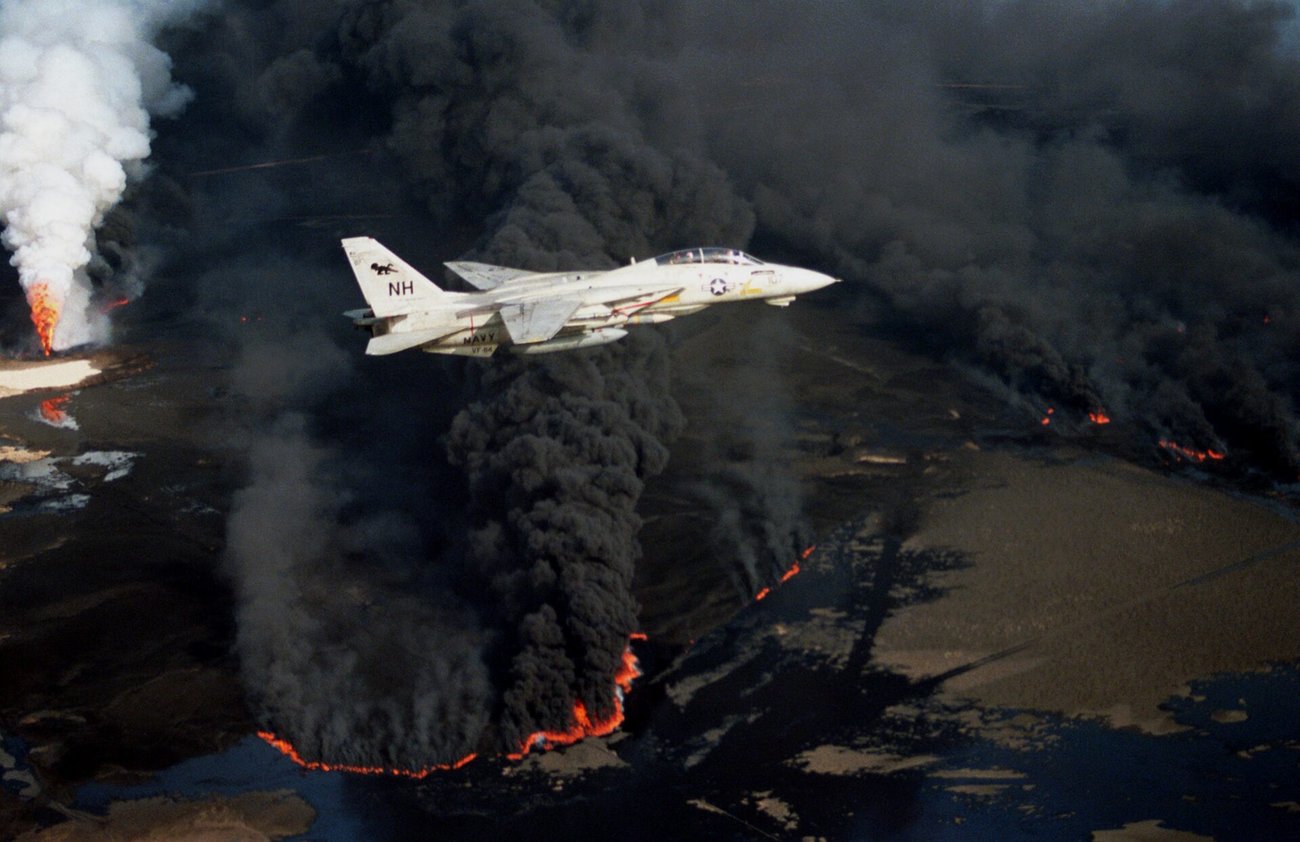
Fighter jet flies over a fire with billowing black smoke

US Navy Grumman F-14A Tomcat flying over a Kuwaiti oil well set ablaze by Iraqi troops during the 1991 Gulf War. (Lt. Steve Gozzo, US Navy)

Mission impossible? Quantifying military emissions

How much does war, and the preparation and recovery from it, contribute to the climate crisis? Nobody knows, because there is no comprehensive accounting of global warming emissions from militaries, military industries, or war, writes Neta C. Crawford. While some military emissions are reported, those are the tip of the iceberg. The failure to quantify the emissions from this sector inhibits the ability to reduce them and keeps them largely sacrosanct.


One can make some educated guesses as to what they may be, which I’ve attempted here. This rough estimate—which is on the conservative side—shows that US and global military, military-industrial, and wartime emissions are enormous and should be factored into our understanding of global warming.

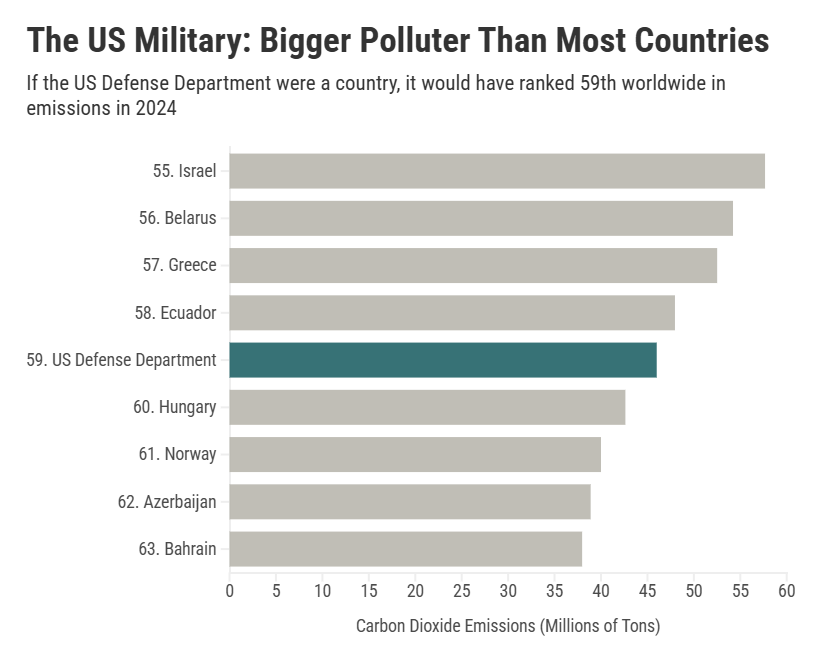
Bar chart reads: "The US Military: Bigger Polluter Than Most Countries" with a subtitle "If the US Defense Department were a country, it would have ranked 59th worldwide in emissions in 2024. Below that is a bar graph. The x-axis reads "#55 Israel" and shows about 55 million tons of Carbon Dioxide Emissions. Then #56 Belarus shows about 53. #57 Green shows 51. #58 Ecuador shows 47. #59 US Defense Department is highlighted and shows 45. #60 Hungary shows 43. #61 Norway shows 40. #62 Azerbaijan shows 38. #63 Bahrain shows 37.

Source: European Commission's Emissions Database for Global Atmospheric Research (2024). Chart made with Flourish. 

The procedures and criteria for nations to make a comprehensive report of their greenhouse emissions were first worked out as part of the 1997 Kyoto Protocol Treaty process.


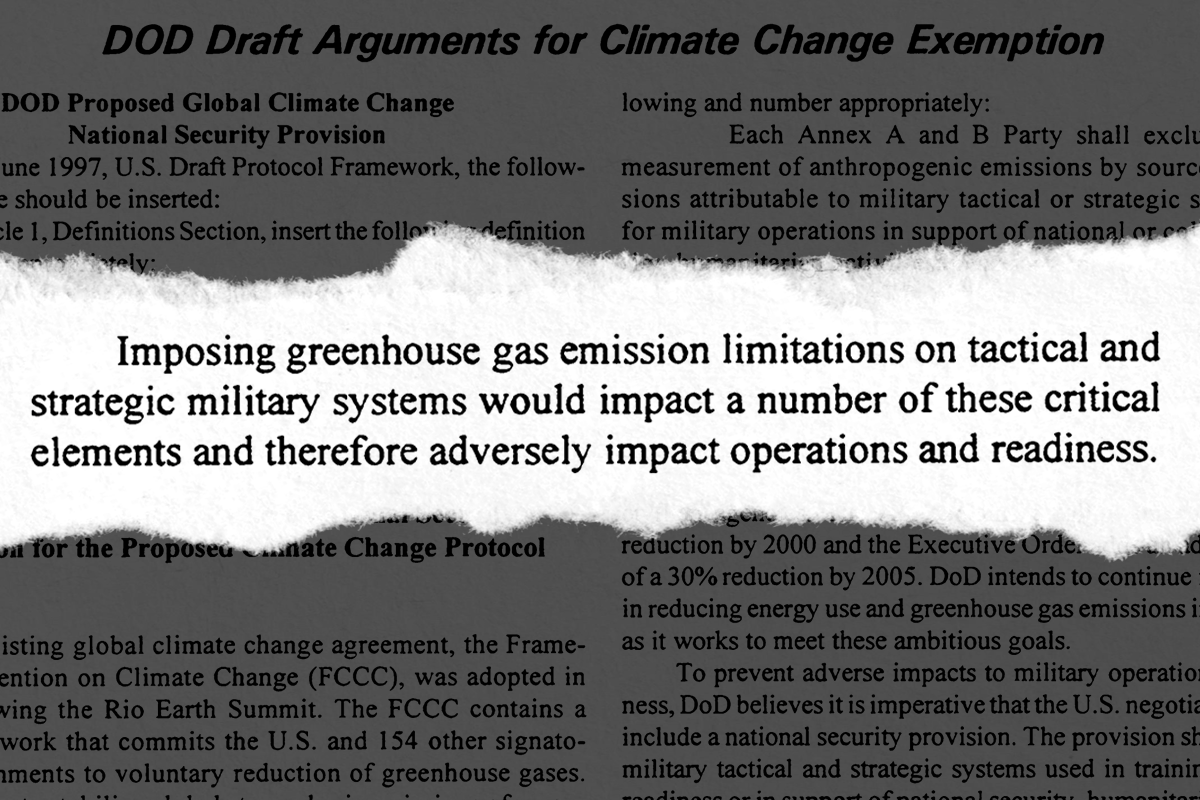
A 1997 Pentagon memo—a piece of rhetorical genius—explained the stakes very clearly: The military was the US government’s single largest fossil fuel user. Ensuring the US military remained preeminent in the world required unlimited fuel use for training and operations. Reporting emissions could lead to a push for reductions, and "limitations on tactical and strategic military systems would … adversely impact operations and readiness."


The Pentagon argued that even a 10 percent reduction in fuel use would harm military readiness and "represent a serious threat to national security."

The background is a picture of an official document with "DOD Draft Arguments for Climate Change Exemption" at the top. In the middle foreground is brighter text reading "Imposing greenhouse gas emission limitations on tactical and strategic military systems would impact a number of these critical elements and therefore adversely impact operations and readiness.

To forestall this, the Pentagon suggested draft language for the Kyoto treaty proposing that parties "shall exclude from its measurement of anthropogenic emissions by sources any emissions attributable to military tactical or strategic systems used for military operations in support of national or collective security, humanitarian activities, peacekeeping, peace enforcement, or United Nations, NATO, and other multinational actions." The Pentagon also proposed excluding measurement of any "emissions attributable to military tactical or strategic systems used in training" for those operations.


The Defense Department also asserted that "to minimize fundamental conflicts between national security and global environmental protection, the Protocol itself must address military operations and readiness so that the [sic] we can pursue and enjoy the fruits of national security as well as the benefits of a healthy planet."


The White House agreed, and the United States successfully lobbied to exempt most military emissions from countries' annual National Inventory Reports of greenhouse gas emissions.

Read more

Neta C. Crawford

Crawford is Professor of International Relations at University of St. Andrews. Prior to that she was the Montague Burton Professor of International Relations at Oxford University, and Professor and Chair of the Department of Political Science at Boston University. 
 
Her books include The Pentagon, Climate Change and War: Charting the Rise and Fall of U.S. Military Emissions, Winner of the American Book Award, 2023 and the Grawemeyer Award, 2024.

Upcoming event

A gif of brightly colored old Bulletin of the Atomic Scientists magazine covers fall into place and then text appears that reads "Go beyond the headlines. Subscribe to the Bulletin magazine today."

Trump wants Kim back at the table. He must focus on coexistence, not denuclearization

Renewed talks with Pyongyang require more than impulsive concessions, writes Ankit Panda. To draw Kim back to the table, Washington must articulate a prepared, high-level vision centered on peaceful coexistence rather than an impossible disarmament timeline. Read more.

Mirror life is a mass-extinction risk we don’t need to take

Scores of researchers and scientific groups have been warning that research toward the creation of mirror life should not be conducted. Not everyone is convinced. Bulletin editorial fellow Georgios Pappas write about the issue in a new piece. Read more.

IN THE NEWS

The Hidden Debt That Apple Owes to the CIA

Without CIA funding that helped keep NeXT afloat in the ’80s, Steve Jobs might not have made a triumphant return to Apple—and the iPhone might not have its foundational operating code. Sharon Weinberger, the Bulletin's new editor-in-chief, writes for the Wall Street Journal. Read more.

The Bulletin is hiring

The Bulletin is searching for an Advancement Services Coordinator, as well as two new Bulletin editorial fellows, to cover the areas of biosecurity and disruptive technologies/AI. Learn more about these positions here.

The defense revolving-door, Silicon Valley edition

Annual US defense expenditures now approach $1 trillion—and could head toward $1.5 trillion in the coming fiscal year. How did we get here? One factor is the stream of national service officials who take positions at private military contractors and lobbying firms, writes John Mecklin, the Bulletin's outgoing editor-in-chief, in his last article in this position.


A new interactive tool from the Bulletin illustrates one piece of the defense revolving door as it has evolved over the last decade: former congressional officials that have wound up working not just at the largest defense contractors, but also for a new class of Silicon Valley firms that has aggressively expanded its Pentagon contracting efforts. Read more.

Recent articles

Your gift fuels our mission to educate and empower. Together we will work to ensure science serves humanity.

Give today

Email Marketing by ActiveCampaign